
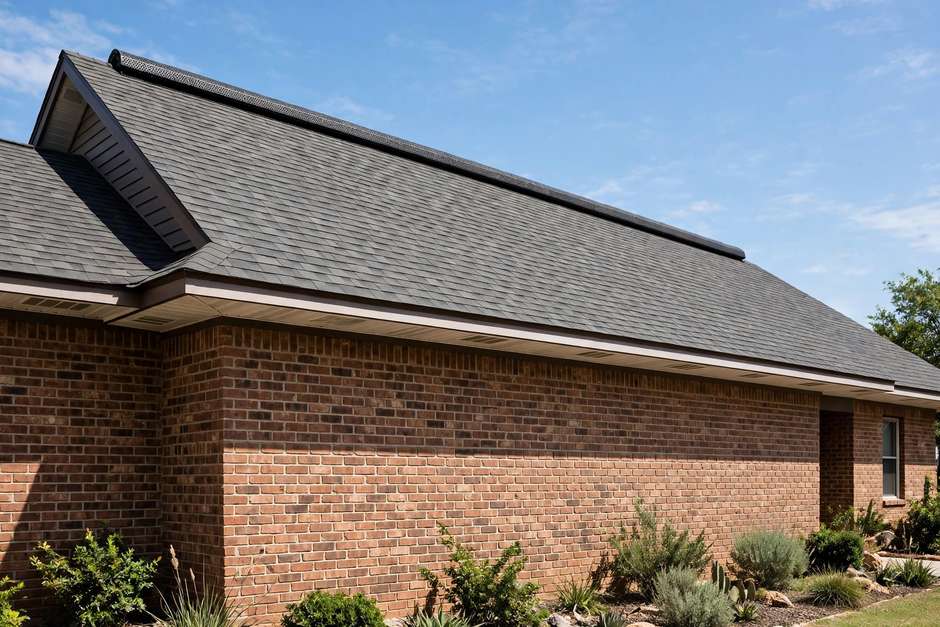
First, the geography: Cedar Ridge is a corridor
Cedar Ridge is not a Duncanville neighbourhood. It is Cedar Ridge Drive, a north-south corridor through the city — the post office sits at 711 S. Cedar Ridge Drive and the CVS at 603 S. Cedar Ridge. Homes along and around the corridor are ordinary Duncanville homes, mostly built in the 1960s to 1980s, and the roofing and energy issues they face are Duncanville issues, not Cedar Ridge issues. This guide explains the mechanics, so you can judge what is happening at your own address.
How roof damage raises the bill
Attic heat. Duncanville summers are long and hot: DFW Airport averages 106 days a year at or above 90°F and 20 days at or above 100°F. A damaged roof lets more of that heat into the attic — through missing or lifted shingles, failed flashing and gaps at penetrations — and a hot attic makes the air conditioning work harder. Poor ventilation makes it worse: the building code requires 1 square foot of net free vent area per 150 square feet of attic floor, reducible to 1 in 300 only where vents are properly split between high and low positions.
Wet insulation. A leak that soaks attic insulation destroys its insulating value. Wet insulation does not dry back to full performance, and it can stay damp for weeks inside a closed attic, adding moisture problems on top of the energy loss. A ceiling stain is often the first visible sign that this has already happened.
Air leaks at the roofline. Damage around vents, pipe boots and flashing opens paths for conditioned air to escape and hot attic air to enter the living space. The roof and the attic work as one system: a breach in the covering is also a breach in the thermal boundary.
What to check before you blame the roof
A higher bill has many causes, and the roof is only one of them. Rule out the cheap ones first: a dirty air-conditioning filter, a thermostat left on a low setpoint, and a failing HVAC system all raise bills without any roof involvement. The roof becomes the prime suspect when the bill jump follows a storm, when you can see missing or lifted shingles, when there is a ceiling stain, or when the attic feels far hotter than it used to. A roof inspection that includes the attic side — decking underside, insulation condition and ventilation — is what separates a roof cause from an HVAC cause.
What repair actually fixes
Repairing the roof stops the water and closes the air paths, but it does not by itself restore soaked insulation or fix long-standing ventilation shortfalls. Those are separate scopes to discuss once the roof is dry: wet insulation needs replacing, and ventilation is judged against the code ratio above. Be wary of any promise that a roof repair alone will cut your bill by a stated percentage — no such figure is verified for Duncanville homes. Our roof repair page explains how a repair is diagnosed, and our roof maintenance page covers the ventilation and cleaning checks that belong in a routine visit. For the inspection step, see how often to get a roof inspection in Duncanville.
If your bill jumped after a storm and you can see roof damage, call (469) 898-7253 to arrange an inspection of the roof and the attic in one visit.