
Flat Roofing in Duncanville Built for Texas Heat and Hail
Ponding, seams and drainage: the flat-roof failure modes
A flat roof fails differently from a pitched roof. Water sits instead of running off, seams open, and drains clog. Cabrera & Sons Roofing designs the drainage first, then the surface. Call (469) 898-7253.
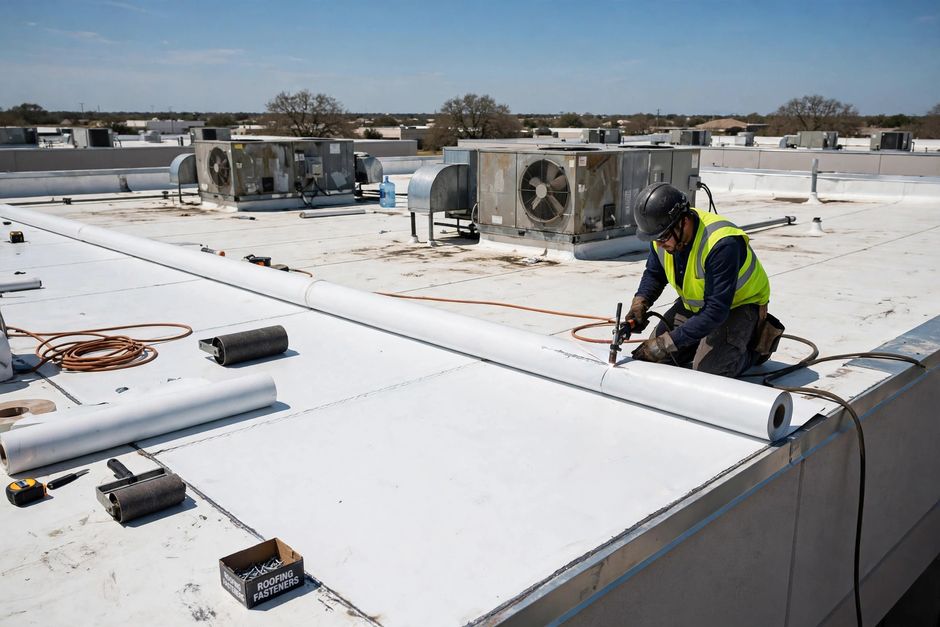
What Flat Roofing in Duncanville Actually Involves
Flat and low-slope roofing in Duncanville covers two kinds of roof: small commercial flat roofs, and low-slope residential sections such as porches, additions and flat garage roofs. The three systems are TPO, EPDM and modified bitumen, and the choice is about drainage, seams and how the roof is used, not about which one is newest.
Drainage is the design question. A flat roof that ponds water will fail at the seams and the drains, whatever the surface is made of. Tapered insulation, clear drains and sealed seams are what keep a flat roof dry, and they are checked before any surface is quoted.
Why Duncanville Owners Choose Low Slope Systems
A flat roof is the right answer for a low-slope section, and owners choose it because the drainage is designed, not assumed.
Drainage Designed First
TPO is a white single-ply membrane with heat-welded seams, and it suits commercial flat roofs that take full sun.
TPO for Full Sun
EPDM is a rubber membrane that is straightforward to repair when a seam or a penetration fails.
EPDM for Easy Repair
Modified bitumen is a layered system that handles foot traffic and standing water on garages, porches and flat sections.
Modified Bitumen for Foot Traffic
A flat roof is inspected differently from a pitched roof: the seams, the drains and the ponding are checked first.
How Our Flat Roofing Process Works
A flat roofing job follows the same order every time, so the drainage is designed before the surface is installed.
Roof Inspection
We walk the roof, check the drains and the ponding, and photograph what we find. You see the photos before you agree to anything.
System and Drainage in Writing
We agree the system with you, TPO, EPDM or modified bitumen, and the drainage work, and put the scope in writing.
Tear-Off and Slope Correction
The old surface comes off, the deck is checked, and the slope and the drains are corrected so water runs off instead of sitting.
Membrane and Flashing
The membrane is installed with sealed seams, new flashing at walls and penetrations, and new drain flashing.
Final Walk and Drain Check
We clear the drains, check the seams, and walk the finished roof with you before we leave.
Local Experience With Low Slope Roofing
Cabrera & Sons Roofing is based at 170 E Hwy 67 in Duncanville, and the flat roofing work is Duncanville work: low-slope residential sections such as porches, additions and flat garage roofs, and small commercial flat roofs. We photograph what we find, give you a written estimate, and clean up before we leave.
- Rated 4.9 out of 5 from 51 Google reviews, with five reviews shown in full on our home page
- TPO, EPDM and modified bitumen compared as systems, with the trade-offs explained
- Drainage designed first, with tapered insulation and clear drains
- Written estimates with photos of your roof, so you can see what we are quoting
- Drains cleared and seams checked at the end of every job
Why Duncanville Calls Us for Flat Roofing
Owners ask us for flat roofing when they want the drainage designed properly, and they judge us on whether the roof stays dry after the next rain.
Drainage Designed First
You get a written estimate that lists the system, the drainage work, the flashing and the haul-away, so you can see what is included.
Written Estimate With Photos
We photograph the deck once the old surface is off, so a decking replacement is something you see, not a line you have to take on trust.
Storm and Insurance Documentation
We document storm damage with dated photos and a written scope, which is what an insurance claim file needs. We do not negotiate claims and we do not waive deductibles, which is illegal in Texas.
Clean Jobsite, Every Day
The drains are cleared, the seams are checked, and the yard is left as we found it.
What Our Flat Roofing Service Includes
A flat roofing job is a defined scope. These are the parts of it, and each one is in the written estimate before work starts.
What's Included
Tear-Off and Deck Check
The old surface comes off, the deck is checked, and soft or rotted decking is replaced and shown to you.
Slope Correction
The slope is corrected with tapered insulation where water ponds, so water runs to the drains instead of sitting.
Membrane Installation
The membrane is installed in the system you chose, TPO, EPDM or modified bitumen, with sealed seams.
Flashing and Drain Work
New flashing at walls, penetrations and drains, fitted to the roof rather than caulked over.
Final Check
The drains are cleared, the seams are checked, and the roof is walked with you before we leave.
Flat Roof Problems We Fix in Duncanville
These are the flat roof problems we see most often on Duncanville's porches, additions and garage roofs. Each one is diagnosed on the roof, not guessed from the ground.
Water that stays on a garage roof
Water that is still standing on a garage roof the morning after rain rots the membrane from underneath and opens the seams. The ceiling below stains first, then the decking softens.
Standing water is a drainage problem, not a surface problem. We correct the slope to the drain and clear the drain itself, so the water has somewhere to go.
Seams opening over a porch
Seams over a porch pull apart as the membrane moves with the summer heat, and each open seam is a leak into the room below. The gap is small at first and easy to miss from the ground.
We re-seal the open seams and probe the rest by hand, so no seam is left untested. Catching a seam early keeps the decking underneath dry.
A scupper blocked by leaves
A scupper blocked by leaves backs water up against the wall of the house, and the porch roof becomes a shallow pool. The stain on the wall below is usually the first sign.
Clearing the scupper and checking the fall to it restores the drainage. The flashing where the roof meets the wall is checked at the same time, because that is where the water was sitting.
Flashing where the flat roof meets the wall
Flashing fails first where a flat roof meets a wall, because the membrane moves with heat and the sealant ages. Water gets behind the flashing and into the rooms below.
Caulk over failed flashing is a temporary cover. A new flashing is fitted to the wall and the roof, and the leak stops at the source.
When Duncanville Owners Call for Flat Roofing
Water standing after rain
Water is still standing on the roof a day after rain, or stains appear on the ceiling below.
Standing water is a drainage problem. The slope and the drains need correcting before the surface is replaced.
Seams pulling apart or blistering
Seams are pulling apart, or the membrane is blistering and cracking.
Open seams and blisters are the membrane failing. The surface needs replacing, and the drainage needs checking at the same time.
Flat garage or porch roof leaking
The flat garage roof or porch roof is leaking, and the pitched roof above it is sound.
A low-slope section leaks on its own terms. It is inspected and quoted as a flat roof, not as part of the pitched roof.
Flat section in a full replacement
The roof is being replaced, and the flat section needs a system that matches the rest of the house.
A replacement is the point where the flat section gets the right system and the right drainage, instead of another patch.
Tools and Methods We Use on Flat Roofs
Tools & Equipment
Seam probe
A seam probe, to test every seam on a small residential flat roof by hand before any work is quoted.
Moisture meter
A moisture meter, to find wet decking and insulation under a garage or porch roof before we close it up over them.
Heat welder
A heat welder, to join TPO seams on a porch or addition roof so the joint holds through the summer heat.
Drain clearing tools
Drain clearing tools, to open a blocked drain or scupper and check the strainer before the membrane goes on.
Level and tape measure
A level and tape measure, to measure the fall across a garage roof, where an inch of slope is the whole drainage design.
Drainage checked first
The drains and scuppers are checked before the membrane is discussed, because drainage decides the system.
Methods & Techniques
Seams probed as laid
Seams are welded or rolled and probed as they are laid, so no seam on a porch or garage roof is left untested.
Flashing fitted at the wall
Flashing is fitted where the flat roof meets the wall, rather than caulked over, because that joint moves with the heat.
Low spots built up
Low spots are built up with tapered insulation where the water was standing, so the roof drains to the scupper.
Final walk with the drain check
The finished roof is walked with you, and the drains are checked with water before we leave.
How Flat Roofing Works in Duncanville
A flat roof fails in ways a pitched roof never does, and the three that matter are ponding, seams and drainage. Water that sits on a low-slope surface rots the membrane from underneath while it looks sound from above, seams pull apart as the membrane moves with heat, and a blocked drain turns the whole roof into a shallow pool. The systems — TPO, EPDM and modified bitumen — are chosen against those three failures, and drainage is the design question that comes before the membrane.
Service Areas
Fairmeadows: Mid-century ranches in north-central Duncanville, where flat sections on porches, additions and garage roofs are inspected and quoted as flat roofing.
Greenbriar Estates: Established lots in south Duncanville, built mostly in the early 1980s, where low-slope surfaces and their drains are inspected as part of the flat roof.
Downtown and Main Street District: The downtown district along Main Street, where commercial and mixed-use roofs with flat and low-slope sections over occupied space are inspected as flat roofing.
Wheatland Road corridor: Low-slope roofs along Wheatland Road, where the seams and drainage are checked first on a flat-roof inspection.
Cedar Ridge Drive: The north-south corridor along Cedar Ridge Drive, where flat sections are inspected and quoted like any other flat roof in Duncanville.
Local Considerations
Ponding is the failure
Ponding is the failure: Standing water a day after rain is not a cosmetic issue. It ages the membrane, stresses the seams and finds the leak path into the rooms below.
Seams move with heat
Seams move with heat: A low-slope membrane expands and contracts with summer heat above 100 degrees, and the seams are where that movement shows first.
Drainage is the design question
Drainage is the design question: Before any membrane is chosen, the slope to the drains and scuppers is settled. The surface is only as good as the drainage under it.
Heavy rain after a storm
Heavy rain after a storm: Spring storms drop heavy rain in short bursts, and a flat roof feels that all at once. The drains and strainers are checked after every one.
What Ponding Water Does to a Low-Slope Roof
On a flat garage roof, ponding shows as a sheet of water still sitting the morning after rain, with a dark stain spreading on the ceiling of the room below. The membrane looks whole from the ladder, but the water has been sitting long enough to soften it from underneath.
The work is finding where the water should go and why it is not going there: the slope to the drain is checked, the drain and its strainer are cleared, and the low spot is built up so the water runs off instead of standing.
Maintenance & Follow-up
Have the drains checked each fall, and after any storm that drops leaves. A garage or porch roof lasts longest when water never sits on it.
An open seam over an addition shows as a gap where the membrane has pulled back from the edge, with the deck underneath stained dark. Each open seam is a leak into the room below, and it starts small.
The work is re-sealing the seam and probing the rest of them, so no seam is left untested. On a small residential flat roof, every seam can be checked by hand in one visit.
Maintenance & Follow-up
Have the seams checked each year, and after any storm with wind. An open seam leaks a little at first and more with every storm.
A blocked scupper on a porch roof shows as water backing up against the wall, with leaves piled at the opening. The roof becomes a shallow pool behind the parapet, and the wall below starts to stain.
The work is clearing the scupper and checking the fall to it, so water runs off the porch roof instead of sitting against the wall. The flashing where the flat roof meets the wall is checked at the same time.
Maintenance & Follow-up
Clear the scuppers each fall, and after any storm that drops debris. A blocked scupper is what turns a porch roof into a pool.
Frequently Asked Questions
Have questions? We have answers. If you do not see your question here, call us at (469) 898-7253.
Call UsTPO vs EPDM: which flat roof is right for my Duncanville building?
TPO is a white single-ply membrane with heat-welded seams, and it suits commercial flat roofs that take full sun. EPDM is a rubber membrane that is straightforward to repair when a seam or a penetration fails. Modified bitumen is a layered system that handles foot traffic. The choice depends on the roof, the drainage and how the roof is used. TPO vs EPDM compared
Why does my flat roof pond water?
A flat roof ponds water when the slope to the drains is wrong, or the drains are blocked. Standing water rots the surface from underneath and opens the seams. The fix is correcting the slope and clearing the drains, not just a new surface.
How long does a flat roof last?
Published DFW commercial sources put TPO and EPDM at around 20 to 30 years, but the real service life depends on drainage, seams and maintenance. A flat roof that ponds water will fail sooner, whatever the surface is made of.
Do I need a permit for flat roof work in Duncanville?
Permit requirements vary by job, so ask the City of Duncanville what your job needs. A full replacement and re-decking require a permit. We do not publish a permit fee figure because the published figures conflict.
What to Check Before You Hire Us
On a low-slope roof, the check that matters is drainage.
What you can check
Ask to see photos of ponding and seam condition before you agree to any work. Ask where the water goes — drains, scuppers and the slope to them — and whether the slope needs correcting.
What customers say
Ask whether the quote covers drain clearing, seam work and flashing at walls and penetrations, or only the membrane. Call (469) 898-7253 and describe the flat section.
Related Services
What Duncanville Customers Say
One of the five reviews on our Google profile, exactly as the customer wrote it. The other reviews are counted in the 4.9 out of 5 aggregate from 51 reviews.
“jared and the crew did an outstanding job on my mother’s flat garage roof in Duncanville. The old roof was in rough shape and needed to be redone, so they got straight to work replacing it. They also fixed the decking and updated the insulation, which made a big difference. The team was professional, efficient, and easy to communicate with, and I’ll be using them again in the future. Cabrera & Sons Roofing is a company that I am happy to recommend to anyone needing a new roof, or a simple repair. Excellent work! ⭐️”
Amelia C
Google review
Get Your Flat Roofing in Duncanville Priced This Week
Call Cabrera & Sons Roofing at (469) 898-7253. Tell us whether your flat roof is a porch, a garage or a commercial roof, and we will inspect the drainage and the surface and give you a written estimate.