
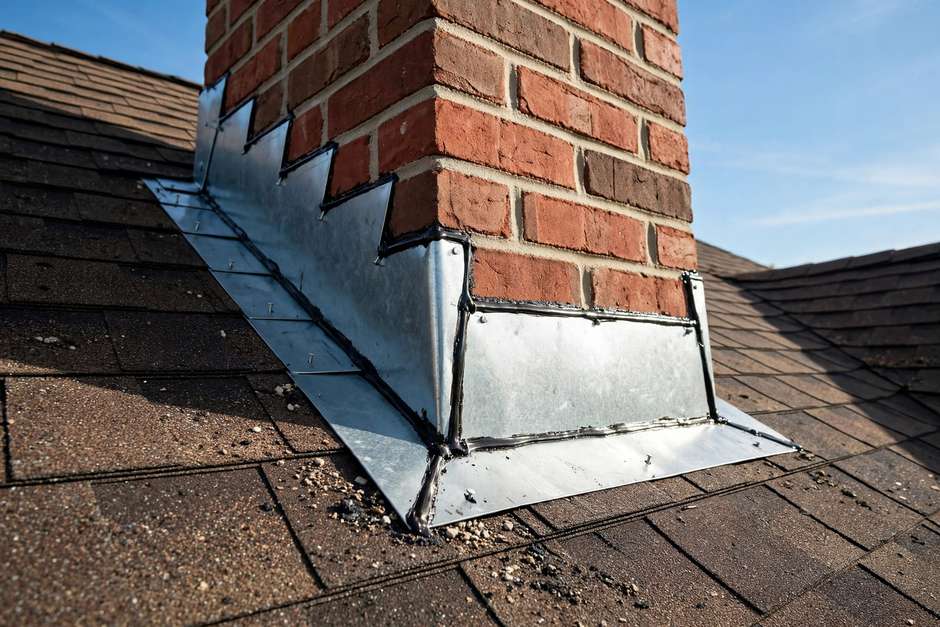
It is almost always the flashing
A chimney is a hole in the roof, and the flashing is what makes that hole watertight: step flashing woven into the shingles on the sides, counter-flashing set into the masonry, and apron flashing on the downhill side. When a chimney leaks, the flashing has usually failed — pulled loose, rusted, cracked at the sealant, or installed without proper step and counter-flashing in the first place. The water runs behind the flashing, rots the decking, and shows up as a stain far from the chimney itself, which is why the stain’s location rarely marks the leak’s source.
Heat is the slow culprit in Duncanville. DFW averages 106 days a year above 90°F, and heat hardens and cracks sealants while wind tugs at flashing edges. Hail dents metal flashing. A flashing system that was sound a decade ago can be the leak today, even though the shingles around it look fine.
Chimney Leaks: Finding the Real Source
- A stain that grows after rain on the ceiling or wall near the chimney, or on the chimney breast itself.
- Visible gaps or lifted metal where the flashing meets the brick, visible from the ground with binoculars.
- Cracked or missing sealant along the counter-flashing line.
- Dampness in the attic around the chimney, or daylight visible beside the chimney from inside the attic.
- Efflorescence or spalling brick — white salt staining or flaking brickwork — which suggests water has been moving through the masonry.
Do not just caulk around the chimney and hope. Caulk over a failed flashing is a patch on a symptom: it may hold for one rain and fail in the next, while the decking underneath keeps rotting. The fix is to remove the old flashing, inspect the decking, and install new step and counter-flashing properly.
How the repair works
A proper chimney flashing repair removes the shingles around the chimney, inspects the decking for rot, replaces any soft decking, then installs new step flashing woven into the shingle courses with counter-flashing set into the masonry joints. The shingles are then reinstalled around it. The work should be water-tested before the crew leaves, and you should receive photos of the old flashing, the decking underneath and the new work. If water is coming in now, see our emergency roof repair page for what to do first, and our roof repair page for how a repair is diagnosed. For the ceiling-stain side of the same problem, see why water drips from the ceiling after a storm.
One caution: a chimney leak can also come from the chimney itself — a cracked crown or failed masonry — rather than the flashing. A roofer who only looks at the flashing and never at the crown has not finished the diagnosis. To arrange an inspection that checks both, call (469) 898-7253.